Do You Need a 240V Outlet or a Hardwired EV Charger?
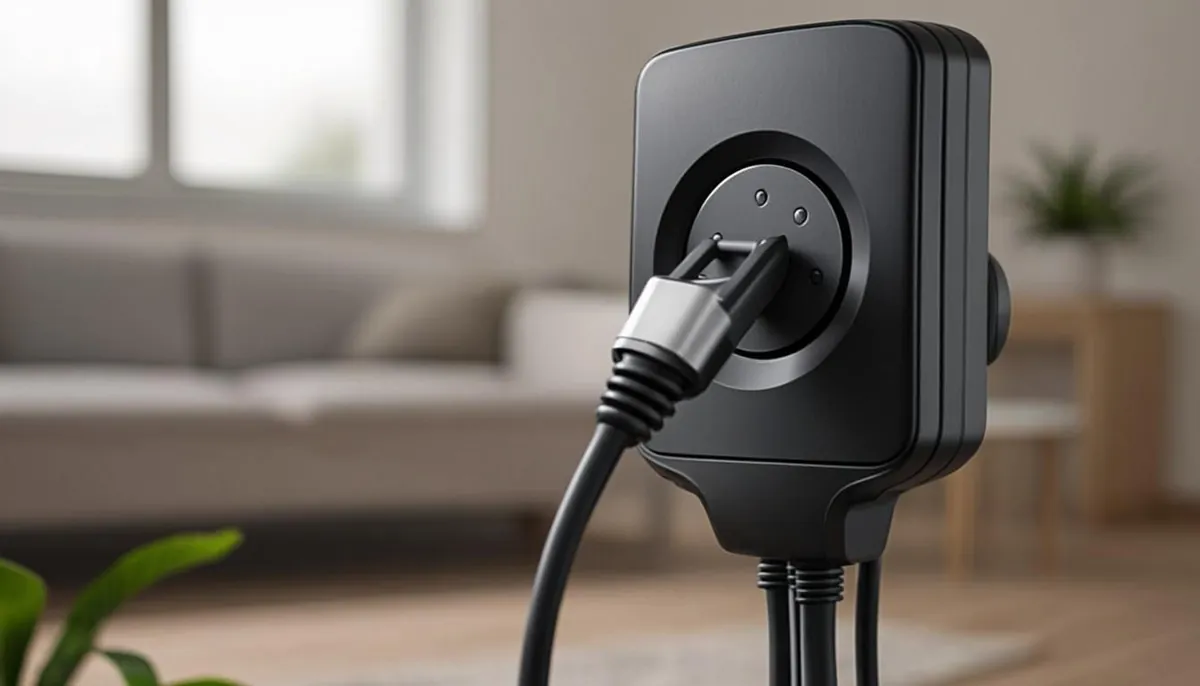
Choosing between a 240V outlet vs hardwired EV charger comes down to how your Bothell home is built, where you park, and how long you plan to keep the equipment. Both routes deliver Level 2 charging, the faster home tier, on a 240-volt circuit. The difference sits at the final connection: one plugs into a receptacle, the other is wired to the circuit with no plug between.
This guide compares them side by side: what each involves, how the performance compares, what the code expects of the circuit, and where each option earns its keep.
What Is a 240V EV Charging Outlet?
A 240V EV charging outlet is a dedicated receptacle on its own circuit, wired directly from the electrical panel. It supplies 240 volts, double a standard household outlet, and it feeds a plug-in Level 2 charger the way an electric range is fed: cord at the car, plug at the wall.
The outlet approach keeps the charger portable. Unplug it and it moves to another bay, travels, or gets replaced without anyone touching the wiring. The trade is that the receptacle becomes part of the charging system, so it must be rated for continuous charging and protected wherever weather can reach it.
What Is a Hardwired EV Charger?
A hardwired EV charger connects directly to the circuit. No receptacle sits in the middle; the unit is mounted to the wall, and the circuit conductors land on its terminals inside a sealed enclosure. Many wall-mounted stations are built for this configuration, and a few models are hardwired only.
Removing the plug removes a connection point that could loosen, corrode, or admit moisture, which is part of why hardwired units are common on exposed walls. The flip side is permanence. Moving the charger or switching models means disconnecting and reconnecting wiring rather than pulling a cord from the wall.
Charging Performance Differences
In daily use, both configurations deliver Level 2 charging on 240-volt power, and neither connection style is inherently faster. Speed follows the charger's amp rating and what the circuit can supply. Two chargers set to the same amperage replenish a battery at the same pace whether one plugs in and the other is wired in; the Department of Energy's Level 2 charging summary at the Alternative Fuels Data Center puts that pace at approximately 25 miles of range added per hour.
Where connection style does matter is holding that output steady over long sessions. A session runs for hours, a worn plug contact can warm up under sustained load, and a tired receptacle becomes the weak link. Hardwired units have nothing that plugs and unplugs, but they depend on clean terminations in the first place. Either setup performs when the parts behind it are sized and installed properly.
Circuit and Breaker Requirements
Both configurations need a dedicated circuit, one that serves the charger and nothing else, and the reasoning is identical for each: EV charging infrastructure is considered a continuous load by the National Electrical Code, as the home charging guidance published by the Department of Energy explains. A circuit that runs for hours near capacity gets designed with headroom, not at its limit.
Breaker sizing follows the charger's input rating, not the connection style. Manufacturers publish those ratings for each model, and Tesla, for one, documents its Wall Connector across a range of breaker sizes rather than one fixed value, per Tesla's Wall Connector installation guide. Wire and breaker are paired the same way whether the run ends at a receptacle or at terminals, and grounding gets verified before the first session.
Outdoor Installation Considerations
Rain is a fact of life in Western Washington, and any charging equipment mounted outside has to live with it. The two configurations diverge here more than anywhere else.
A plug-in setup depends on its protection package: a weather-rated receptacle under a cover that keeps the connection dry while a charger is plugged in, not just while the outlet sits empty. Covers built for that job work well, yet they add hardware that must stay sealed through years of use, and the plug interface meets the air every time a cord goes in.
A hardwired unit sidesteps the problem by having no exposed receptacle at all. With the wiring sealed inside an outdoor-rated enclosure, hardwired chargers are the usual pick for carports, open driveways, and walls that take direct weather. Either way, the charger itself must carry an outdoor rating; an indoor-only unit does not belong outside.
Installation and Maintenance Differences
Day to day, the setups differ less in how they charge and more in how they are installed, moved, and cared for. On the wall, the difference is easy to spot: a receptacle with a cord hanging from it, or a conduit entering a sealed cabinet. Both are correct work; the right one depends on the location and your plans.
A receptacle serves charger after charger; a hardwired unit is one piece from breaker to enclosure. The table below sums up the practical gaps.
| Consideration | Plug-in on a 240V outlet | Hardwired |
|---|---|---|
| Installation work | Set the receptacle and its dedicated circuit, then plug in the charger | Mount the unit and wire it directly to the circuit with sealed terminations |
| Moving or replacing | Unplug and relocate; the outlet stays ready for the next charger | Disconnect and reconnect wiring; an electrician makes the swap |
| Outdoor protection | Weather-rated receptacle plus a cover rated for a connected cord | Outdoor-rated enclosure with no receptacle exposed to the weather |
| Typical upkeep | Occasional check of plug and receptacle condition; contacts wear with use | Little to service beyond the cable and connector |
Which Option Is Better for Your Home?
Neither configuration wins outright; each solves a different problem. Pick the outlet route when flexibility ranks first: a charger that can be replaced when a better model arrives, taken along if you sell the house, or swapped to match a new vehicle. That is the case for a 240V EV charger outlet installation in Bothell: a code-compliant circuit that outlives whatever is plugged into it.
Pick hardwired when the spot is settled and the wall faces the weather. Sealed enclosures, no plug interface, and a clean look suit homeowners who treat the charger like the water heater: installed once, serviced rarely. The circuit work behind both options is nearly identical, and either can be handled as part of a full EV charger installation in Bothell.
Undecided? The site visit usually settles it, because panel capacity, wiring distance, and exposure tend to push each home toward one answer.
A 240V outlet vs hardwired EV charger is not a forever commitment, but it is worth deciding with the parking spot, the panel, and the weather in view. Tell us which charger you are considering and where the car sleeps; we will recommend the configuration that fits and put the scope in writing.
Call (425) 285-8045 to talk through your setup; the line is answered around the clock.